Guide
Who actually answers your AITA post?
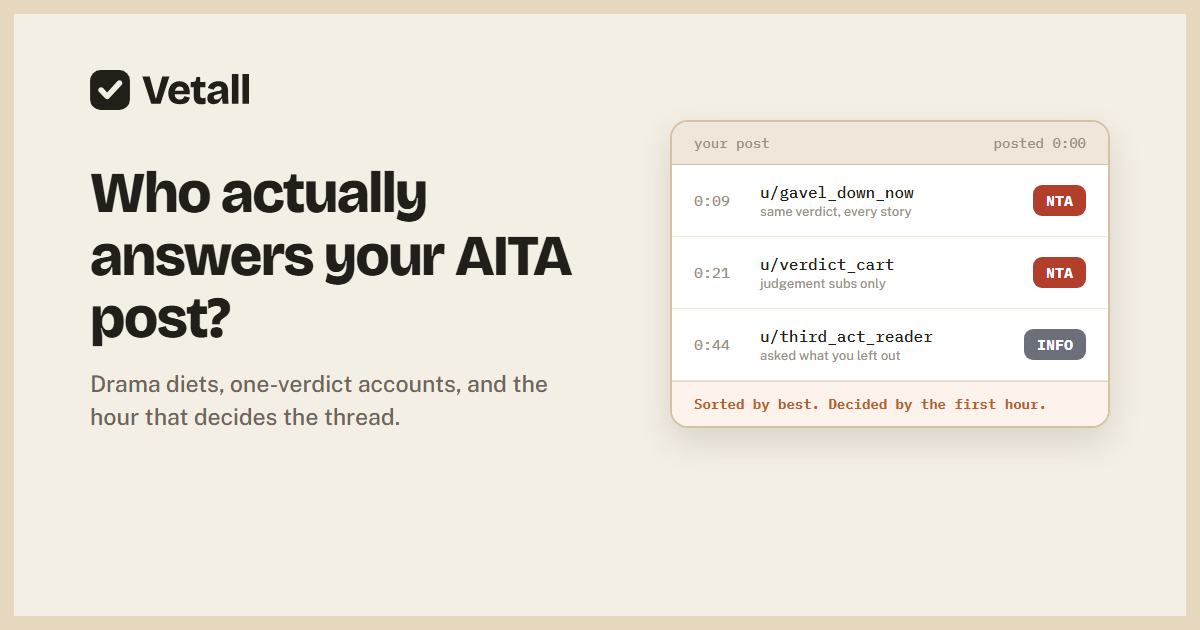
You post the argument at midnight, and by breakfast a few hundred strangers have ruled on your relationship. Before you carry that verdict home and act on it, it is worth knowing who sat on your jury, because the jury did not assemble at random.
What a judgement sub actually is
On paper, it is a place to get impartial verdicts on everyday conflict. In practice it is an entertainment engine. The stories are the content, the verdicts are the applause, and the whole thing runs because reading other people's arguments is compelling in a way tidy resolutions are not. None of that is sinister, and plenty of posters genuinely get useful perspective. But the incentives deserve your attention: a sub that runs on drama attracts dramatic stories and dramatic readers, and both of those quietly distort what happens to your ordinary, complicated argument when you drop it in.
The drama diet
Open the histories of the loudest commenters on any big judgement thread and a pattern appears quickly: for a fair share of them, judgement subs are their whole visible Reddit life. Story after story, verdict after verdict, every day. There is nothing wrong with the hobby. But think about what that diet does to calibration. Someone who reads forty conflict stories a day has a reference library full of villains, because extreme stories are the ones that surface. Your sister's seating-plan mistake is being judged by people whose recent caseload was arsonists and bigamists. Ordinary faults look either invisible or monstrous from there, and rarely their actual size.
The diet also shapes what gets read at all. A measured post with an honest, boring title sinks; the outrageous ones surface and set the house style. Post an ordinary conflict into that stream and it will be read in the genre's terms, because the genre is what everyone came for.
One-verdict accounts
Some accounts decided the verdict before your story loaded. Scroll a prolific judge's history and you will occasionally find the same ruling delivered to everyone: every poster is in the right, comfort dispensed on a loop, or every poster is the villain, delivered with the same relish. The story is an occasion; the verdict is a reflex. A ruling that never varies with the facts carries no information about you, whichever way it happens to fall on your thread.
The first hour decides the thread
Judgement threads do not weigh comments so much as snowball them. The first few verdicts set a direction. The default sort lifts them. Every later reader now meets your story pre-judged, and agreeing with the top comment is cheaper than reading your post carefully. Dissent arrives late, sinks, and goes unread. What looks like the settled opinion of hundreds is often the opinion of the first handful of readers, amplified by everyone after them. Which means the identity of whoever happened to be online in your first hour matters far more than it should.
You can watch it happen in real time. An early request for information sends a thread one way; an early verdict sends the same story somewhere else entirely. Neither outcome reflects the story. Both reflect the queue.
Taking what is actually useful
The thread is genuinely valuable. It is just usually valuable for the wrong thing. Ignore the verdict count, which measures the first hour and the sort order. Mine the comments for questions you had not thought to ask yourself, and for the details strangers keep flagging as missing, because those gaps are usually where the real story lives. One reader asking for information you left out is worth more to you than fifty verdicts. And remember what was actually judged: your telling of it, a first draft written by one side, while angry.
Before you post at all
A little preparation improves the jury you get. Decide first what you actually want: perspective, or validation. Both are on offer, and the thread will happily supply either. Write the awkward facts in before a commenter digs them out of you, because a story that survives its own worst details earns more careful answers. Then hold the early result lightly. The verdict at twenty minutes and the verdict at a day are often two different threads wearing the same title.
Knowing which judge you have got
Vetall reads roughly two hundred of an account's recent public comments and posts and turns them into measurements: how widely the account roams beyond one sub, how much of its output is the same text resurfacing, its rhythm, its age. An AI weighs those into a score and a band on a badge next to the username, so you can tell the reader from the reflex before you take either one to heart. Accounts too thin to judge return exactly that, rather than a guess.
See who is judging, at a glance.
A badge on every username in the thread, built from each account's public history. 7 full checks free, and any account already checked shows its band to everyone, free forever.
Add Vetall to Chrome, freeNo card required.