Guide
Lawyer up, cut them off: when Reddit advice is a pattern, not advice
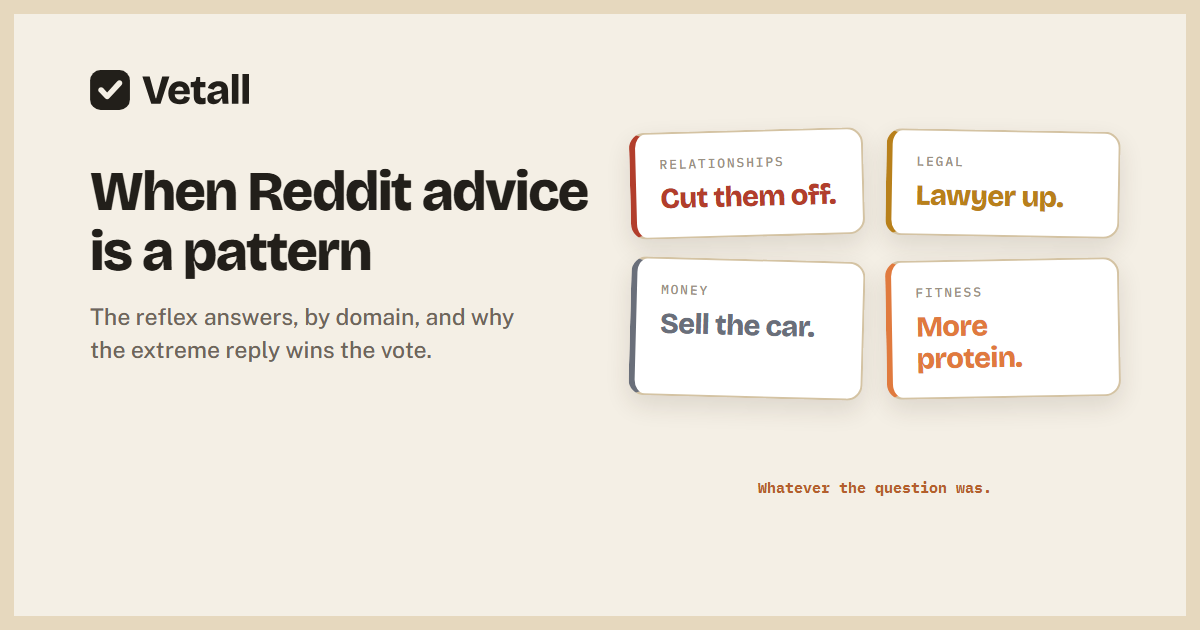
Ask Reddit about your marriage and someone will tell you to end it. Ask about your boss and someone will tell you to sue. These are not answers to your question. They are the answers, sitting ready, waiting for a question to attach themselves to. Learning to recognise them changes how you read every advice thread on the site.
The reflex answers, by domain
Every advice territory on Reddit has its stock prescription. You have seen all of these, probably today.
| Domain | The reflex | What it skips |
|---|---|---|
| Relationships | Cut them off. Leave. Red flag. | Everything you would lose by leaving, which the commenter does not have to carry. |
| Legal | Lawyer up. Sue. Document everything. | What a consultation costs, and whether one polite letter would have fixed it. |
| Money | Sell the car. Never lend family a penny. | The people and obligations your money is tangled up with. |
| Health and fitness | More protein. Just run the programme. | Your injury, your age, and the reason you asked instead of just doing it. |
None of these sentences is wrong everywhere. Each is wrong as a default, and a default is exactly what it becomes when it arrives within minutes, under every story, from accounts that never ask a question first.
Why the extreme answer wins the vote
Voting is the whole mechanism, so look at what voting rewards. Certainty reads as competence; hedging reads as weakness. "It depends" is correct about most things and exciting about none of them, so it sinks. A clean, dramatic prescription resolves the story, and readers vote for resolution the way they vote for a good ending. Meanwhile the cost falls on nobody in the room: upvoting "divorce him" costs a stranger nothing, and they will never learn how it went, because nobody comes back to grade the advice. A system with those incentives selects for confidence and drama. It would be strange if it did anything else.
The asymmetry runs deeper, because nobody returns to grade the outcome. The poster who took the nuclear option rarely comes back a year later to report, and the thread is archived if they do. Extreme advice keeps its wins on the front page and buries its losses, a record no honest adviser could match.
The comment is not the tell. The history is.
Here is the part most people skip: any single "lawyer up" might be exactly right. You cannot judge the comment from the comment. You judge it from the account. Open the history and scan what this person tells everyone else. Do their answers change with the facts? Do they ask questions before ruling? Or does every thread, whatever its shape, receive the same prescription? An account that says "cut them off" to every poster it meets is not advising you. It is reciting, and you happened to be standing in front of it.
What responsive advice looks like
The useful commenters are recognisable too, and worth deliberately seeking out in the thread:
- They ask for a missing fact before ruling, because the answer genuinely depends on it.
- They price their own advice: what it costs, how long it takes, what it risks.
- They acknowledge they are hearing one side, told by the person it flatters most.
- They propose the smallest workable next step, not the nuclear one.
- They change their mind in the same thread when new details arrive. This is the rarest and best sign of all.
When you find one of these commenters, put your follow-up to them directly. They tend to answer, because they were reading rather than performing. The reflex accounts rarely reply at all; the thread has moved on, and so have they.
Running the check in one minute
Click the username. Sort their comments by new and read fifteen, counting how many contain the prescription you have just been handed. Look for question marks while you are there: an adviser who never asks anything has never needed anyone's facts. Then look at where the answers land. An account active in one or two subjects it plainly knows is drawing on something. An account dispensing certainty across every domain on the site, legal on Monday, medical by Wednesday, is drawing on confidence alone.
Reading the adviser at a glance
Checking whether an account says the same thing everywhere means reading its history, and nobody does that for every commenter in a fifty-reply thread. Vetall does. A check reads roughly two hundred recent public comments and posts, measures repeated text, subreddit spread, rhythm and age, and an AI weighs the patterns into a score and band on a badge next to the username, with up to three signals explaining it. The reciter and the listener stop looking identical.
Know whose advice you are taking.
A badge on every username, built from the account's public history. 7 full checks free, and any account already checked shows its band to everyone, free forever.
Add Vetall to Chrome, freeNo card required.