Guide
The signals behind a Vetall score, explained honestly
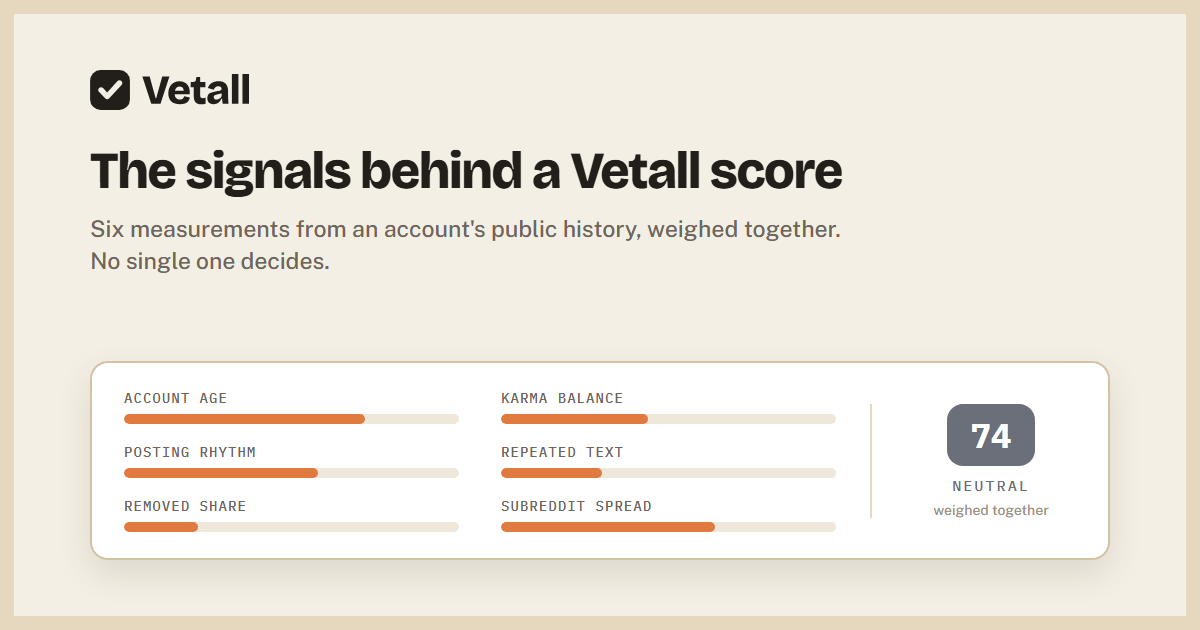
A trust score you cannot interrogate is just a vibe with a number attached. This page lists every measurement a Vetall check takes, what each one catches, how each one can mislead on its own, and why the score only ever comes from the pattern they make together.
What a check actually reads
When you check an account, Vetall reads roughly two hundred of its most recent public comments and posts. Nothing private, nothing deleted, nothing you could not scroll to yourself. That text is reduced to six measurements, an AI weighs the pattern they make, and the result is a score from 0 to 100, a band, up to three named signals, one line of advice, and a stated confidence level. The text itself is discarded after scoring; only the measurements and the verdict are kept. Accounts too thin to measure return not enough to judge rather than a guess. That is the whole machine. Here it is at a glance, then one measurement at a time.
| Signal | What it catches | Weak alone because |
|---|---|---|
| Account age | Throwaways and purpose-made accounts | Aged accounts are bought and stolen |
| Karma balance | Accounts that broadcast but never converse | Some real people rarely comment |
| Posting rhythm | Schedules humans do not keep | Shift work and time zones look odd too |
| Repeated text | Scripts pasted across threads | Honest answers repeat honestly |
| Removed share | Accounts communities keep rejecting | One strict subreddit can inflate it |
| Subreddit spread | Single-purpose accounts | Devoted specialists exist |
The six measurements
Account age
Most throwaway and purpose-built accounts are young, because bans keep resetting them, so age is the cheapest useful signal there is. It is also the most gamed: aged accounts are bought and stolen precisely to pass age checks, and a stolen account inherits its victim's record until its behaviour changes. Meanwhile plenty of genuine people made their account last month. Age moves the odds. It settles nothing.
Karma balance between posts and comments
The split between post karma and comment karma describes how an account lives. Heavy posting with little conversation is the shape of promotion, reposting, and spam; conversation is harder to fake at volume. Alone it misleads: photographers and artists legitimately skew towards posts, and lifelong lurkers who finally speak skew the other way.
Posting rhythm
When an account posts can be as telling as what it posts. Activity spread evenly around the clock, or arriving in dense mechanical bursts, is a schedule people do not keep. Alone, though, rhythm accuses the innocent: shift workers, insomniacs and frequent travellers all look strange on a clock. What it really catches is regularity too perfect to be a life.
Repeated text
The same sentences recurring across a history are the signature of operating at volume: pasted pitches, pasted reassurances, pasted outrage. It is one of the strongest signals there is, and still not proof by itself. A helpful hobbyist types the same correct answer to the same beginner question for years, and means it every time.
Moderator-removed share
You cannot read removed comments, but the share of an account's comments that moderators removed is a record of decisions made by people who did read them. A high share means communities keep rejecting what this account contributes. Alone it can mislead: one heavily moderated subreddit, or opinions that are unpopular rather than dishonest, can push the number up.
Subreddit spread
Real people wander. They argue about football, ask for tech support, complain in their city's subreddit. An account whose entire visible life happens in one narrow lane, especially a commercial one, behaves like a tool rather than a person. But specialists exist, and someone who only ever posts about mechanical keyboards is probably just someone who loves mechanical keyboards.
Why no single signal decides
Every measurement above has an innocent explanation, and that is the point. A young account is a person who just arrived. Odd hours are a night shift. Repetition is patience with beginners. What has an innocent explanation far less often is coincidence: a young account with pasted text, a narrow spread and a rising removed share is a different object from any of those things alone. The AI's job is to weigh that coincidence, which is why the output is a score on a spectrum with a confidence level, not a stamp. It is also why the same signal can appear in a Trusted account's check and a High Risk one's. Signals describe. The pattern decides.
What the check refuses to guess
Two refusals are built in. An account with too little public history returns not enough to judge, because a confident number built on nothing would be worse than no number. And the score never claims to know a person: it cannot see private messages, deleted history, or intent. It reads behaviour, which is evidence, and evidence is how it should be treated.
See the signals on any account.
One click on any Reddit username shows the score, the band, and the signals that drove it. Your first 7 checks are free, and any account someone has already checked shows its band to everyone with the extension, free forever.
Add Vetall to Chrome, freeNo card required.