Guide
What AI can and cannot tell you about a Reddit account
There is a version of this page that sells you a robot and a version that scoffs at one, and both write themselves. The honest version is narrower. An AI reading a Reddit account is very good at one specific job, and once you can name that job you know exactly how far to trust the result.
Patterns, not truth
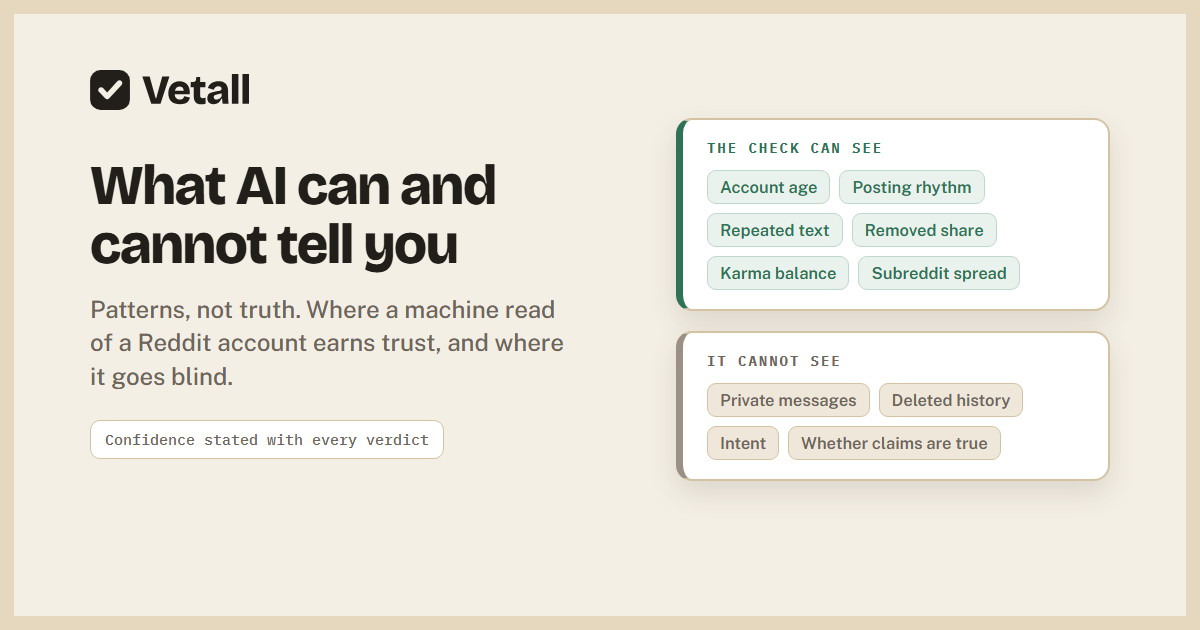
When Vetall's AI reads an account, it reads roughly two hundred recent public comments and posts and reduces them to measurements: account age, the karma balance between posts and comments, posting rhythm, repeated text, the share of comments moderators removed, and subreddit spread. Notice what is not on the list. It never learns whether a claim was true, whether an item shipped, or whether the advice worked. It measures how the account behaves, not whether the account is honest. The two usually travel together, which is why pattern reading works at all. They sometimes do not, which is why it has limits.
What a machine read is genuinely good at
Scale and memory. Two hundred items are read in seconds; done properly by hand, that is an evening. Repetition shows up across months and across subreddits, in threads no human would think to open side by side. The removed share is counted, not guessed from gaps. And the reading never varies: the machine does not get charmed by a friendly tone, tired by the tenth account, or hurried by a deal that expires tonight. Whatever else you think of machines, the twentieth stranger gets exactly the scrutiny the first one did.
There is also a fairness argument that is easy to miss. Human judgement of strangers leans on proxies: spelling, fluency, tone, a username that sounds right. A pattern read ignores all of it. An account that writes clumsily but has years of ordinary, varied, unremoved history measures well. One that writes beautifully and pastes the same pitch across dozens of threads does not. Judging behaviour rather than polish matters, because polish is the thing con artists practise.
Where it goes blind
| The check can see | The check cannot see |
|---|---|
| When and how often the account posts | Anything said in private messages |
| Text that repeats across its threads | Content deleted before the check ran |
| The share of comments moderators removed | Why the moderators removed them |
| How widely it moves between subreddits | Whether any claim it makes is true |
| The shape of its public record | What its owner intends to do next |
Intent is the heaviest entry in the right-hand column. Patterns describe the past. People decide the future, and no measurement of last month constrains what someone chooses to do tomorrow.
The stolen account blind spot
The sharpest limit deserves its own section. A stolen aged account inherits its victim's history: years of ordinary comments, a healthy spread, a clean removed share. Until the new owner's behaviour diverges, the measurements describe the victim, and the verdict will too. This is a structural limit of any history-based check, human or automated, not a bug in one product. It is why a good band on an old account should be read as good odds rather than a guarantee, and why recent behaviour matters more than the lifetime picture when money is on the table.
The practical mitigation is recency. A takeover shows first in fresh behaviour: new repeated text, a new rhythm, a sudden narrowing of what the account talks about. Because a check reads the account's recent comments and posts rather than its whole life story, changed behaviour moves the verdict, but only once there is enough of it to measure.
Why "not enough to judge" is a feature
A system that must always produce an answer will guess when the data runs out. Vetall does the opposite, twice over. Accounts too thin to measure return not enough to judge rather than a number, and every verdict that is given carries a confidence level, so you can see how firmly the evidence points. This costs the product some theatre: a decisive score on every account would look more impressive. But a shrug is the honest output on an empty history, and a tool that refuses to shrug should worry you.
When to trust the machine read, and when not to
Trust it as a filter. It answers the question you cannot afford to research for every stranger: does this account's public record look ordinary, and if not, why not. Do not trust it as a verdict when the stakes are real. For a serious trade, read the recent history yourself with the signals as your starting list, and keep a reversible payment between you and being wrong. A pattern read describes how an account behaves, never who a person is, and no read of public history can promise what a stranger will do next.
Get the pattern read in one click.
Score, band, signals, one line of advice and a confidence level, on any Reddit username. Your first 7 checks are free, and any account already checked shows its band to everyone with the extension, free forever.
Add Vetall to Chrome, freeNo card required.