Guide
Astroturfing on Reddit: how shills fake grassroots opinion
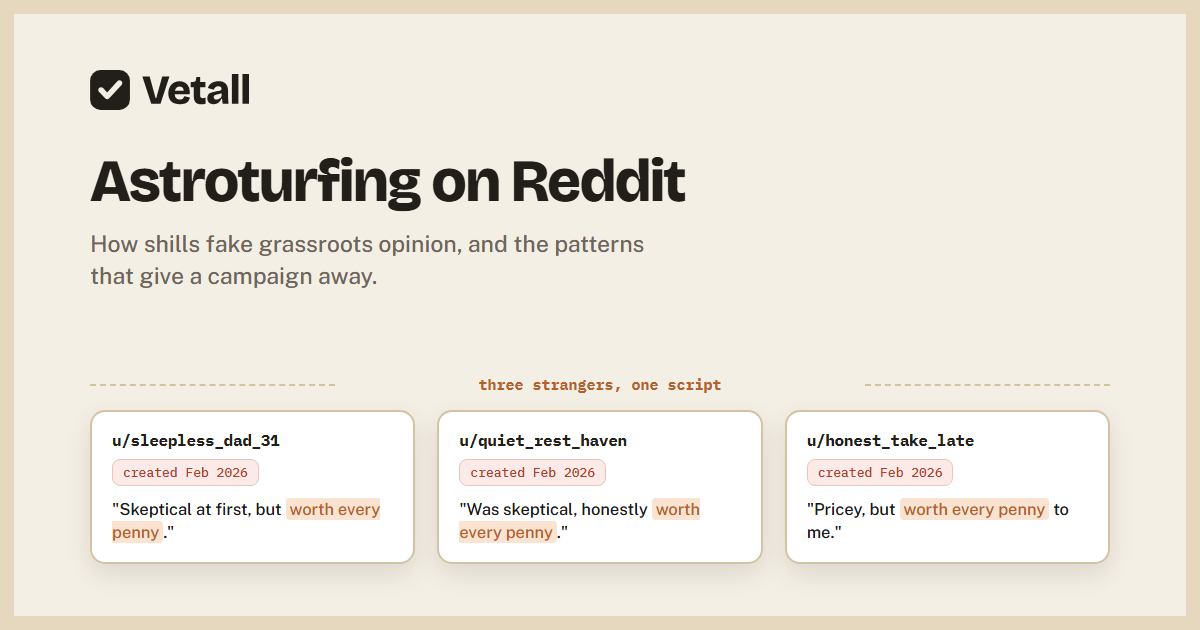
An advert declares itself, and you discount it on sight. A stranger in the comments who switched last month and never looked back is worth far more than an advert, for exactly one reason: you believe nobody paid them. Astroturfing is the business of manufacturing that stranger.
Why the trick pays for itself here
People have learned to bolt the word "reddit" onto product searches because they want opinions from someone with nothing to sell. That habit is precisely what makes the comments worth buying. A seeded recommendation sits in a thread that ranks in search engines for years, read each week by new buyers who take it as the disinterested voice of a real user. Compared with advertising that announces itself and dies with the campaign, a comment that passes as grassroots is absurdly good value. Which is why an industry exists to write them.
The writing is not even the hard part: the register of a happy customer is public, abundant and easy to copy. The hard part is faking a believable history behind the comment, which is why histories are where campaigns get caught.
Where campaigns operate
Four habitats cover most of it. What-should-I-buy threads, where one planted answer meets a reader who has already taken out their wallet. Brand-war threads, where two products are compared and each side's "long-time user" may be on a rota. Launch windows, when a new product's mentions need warmth and volume in a hurry. And complaint threads, where the goal is not praise but dilution: a genuine problem post gets buried under a chorus of "strange, mine has been flawless". The same playbook runs for products, services, apps and causes alike.
Products are just the visible end. The same mechanics push opinions: a talking point dressed as a personal story, seeded across discussion threads by accounts that agree with one another a little too smoothly. The tells below apply unchanged; only the merchandise differs.
The patterns that give a campaign away
No single account gives a campaign away. The unit of detection is the group, because the operator's constraint is industrial: many accounts have to be created, aged and scripted at once, and industry leaves a symmetry that individuals never do.
- Age clusters. The enthusiastic strangers were all created in the same narrow window. Real fans of anything have account ages scattered across a decade; a batch has a birthday.
- Single-product histories. Open the profile and the account's whole visible life orbits one product or one fight. Real users mention a purchase and go back to arguing about football.
- Synchronised talking points. The same comparison, the same benefit, and above all the same staged concession, "pricey, but worth it", appearing across supposedly unrelated accounts. Scripts survive paraphrase; the skeleton shows through.
- Convergent timing. Accounts that post rarely, or have sat quiet for months, all arriving in one thread within the hour. Ordinary people do not coordinate their reawakenings.
Checking a suspicious thread by hand
- Open the profiles of the three or four most enthusiastic commenters. Not the thread, the accounts.
- Compare creation dates. A cluster is the loudest tell on this page.
- Scan each history for life beyond the product. Hobbies, complaints, arguments about anything else at all.
- Take the phrase they share, put it in quotes, and search Reddit for it. A script leaves copies.
- Check when each account last posted before today. A row of long-dormant accounts waking for one thread answers the question.
Do this for the one thread that is about to cost you money, not for everything you read. The point is not to become an investigator. It is to know the read exists, so that a wall of warm agreement stops being automatically persuasive.
The quieter damage
The worst thing a campaign costs you is not one bad purchase. It is the discount you start applying to everything afterwards, until every enthusiastic stranger reads as a plant and honest threads lose their value too. Most opinion on Reddit is still real people being freely, genuinely opinionated, which is exactly why the fakes imitate it. The answer is not blanket suspicion. It is a quick look at histories when the stakes are real, which keeps the useful trust and retires the naive kind.
What the measurements catch
The giveaway patterns above are measurable, and they are what a Vetall check measures: account age, repeated text, how narrowly an account's activity clusters around one subject, its posting rhythm, the balance of posts to comments. A check reads roughly two hundred recent public comments and posts, and an AI weighs the patterns into a score and a band on a badge beside the username. In a thread full of warm strangers, the badges tell you which ones have a history of being people.
Read the room's actual history.
A badge on every username in the thread, built from each account's public activity. 7 full checks free, and any account already checked shows its band to everyone, free forever.
Add Vetall to Chrome, freeNo card required.