Guide
Is this Reddit seller legit? The five minute check
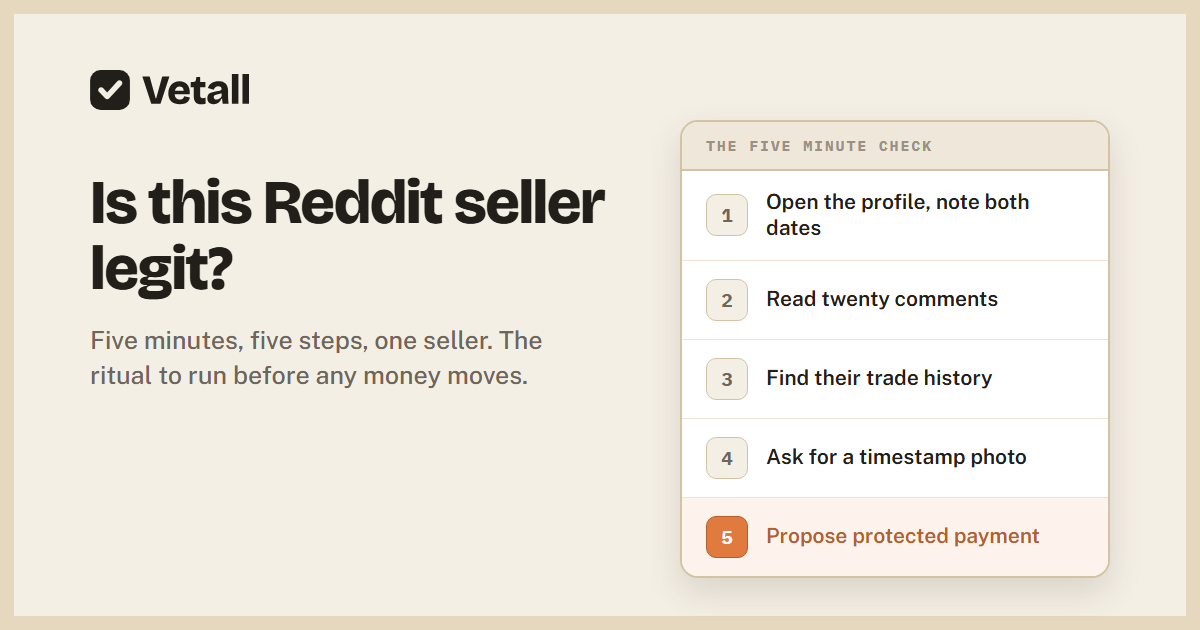
Scam guides tend to assume a rogue's gallery. Real buying is narrower than that: one listing, one seller, one decision. This is the five minute ritual to run on that single account before any money moves.
What five minutes buys you
Most marketplace losses on Reddit are not sophisticated. They rely on a buyer who checked nothing, because the listing looked normal and the price made hesitation feel expensive. Five deliberate minutes reverse that. A legitimate seller passes every step below without ever knowing you took them. A scammer has to fail at least one, because the steps test the things that cannot be faked in an afternoon: a lived-in history, a reputation held in public, and a payment that can be pulled back.
You are not trying to catch anyone out. You are giving one stranger five chances to be ordinary.
The order matters, too. The steps run from cheapest to most decisive, so most bad listings fall out in the first two minutes and never cost you a message. Run them in sequence and stop at the first hard failure. There is no prize for finishing the list on a seller who has already failed it.
Minute one: open the profile
Note two dates: when the account was created, and when its current run of activity began. Created years ago and steadily active ever since is the shape you want. Created last month is a warning you can at least price in. The dangerous shape is the third one: an old account that sat silent for years and woke up recently. Aged accounts are bought and stolen precisely to pass the glance you just gave this one, so a long gap between created and active matters more than the age itself.
While you are there, look at the karma split. Plenty of post karma with almost no comment karma means the account broadcasts. It does not participate.
Minute two: read twenty comments
Scroll the comment history and read twenty, quickly. You are asking one question: does a person live here? Hobbies, arguments, a complaint about a commute, a joke that landed badly. A seller whose entire visible life is selling has a function, not a life.
Watch for repetition while you scroll. The same sentence pasted under different posts means a script working at volume, not a person answering questions. Copy one distinctive phrase of theirs into Reddit search, in quotes, and see where else it appears.
Minute three: find the reputation held in public
Search the username inside the marketplace subreddit itself. Established trading subs keep confirmed-trade threads and award flair for completed deals, and both are worth more than anything the seller tells you directly. Read the replies under their past listings too: previous buyers sometimes leave warnings a seller cannot delete.
No presence in the sub, plus a big-ticket listing, is the classic combination. It is not damning on its own. It just means the last two steps now carry all the weight.
One refinement: check that the trade history matches the goods. A dozen confirmed trades in mechanical keyboards says little about a sudden camera listing. Reputation is specific, and scammers borrow it from one category to spend in another.
Minute four: the timestamp test
Ask for one photo: the item, next to a handwritten note with your username and today's date. It costs an honest seller thirty seconds and a scrap of paper. It is close to impossible for someone reselling photos lifted from an old listing. Refusal, excuses, or a suspiciously polished photo with no note ends the conversation, politely.
Minute five: the payment question
You never have to accuse anyone of anything. Simply propose PayPal Goods and Services, or a card payment through an invoice, and watch what happens. A legitimate seller may grumble about the fee, then accept, or ask to split it. Someone who insists on friends-and-family, crypto, gift cards or a wire is telling you the plan, because those methods share one property: once sent, gone.
This question outweighs every other signal, because it is the only step that tests the scam itself rather than the scammer.
If the answer is friends-and-family or nothing at all, walk away, even when every earlier step was spotless. The earlier steps measure the seller. This one prices the mistake, and a spotless seller with an irreversible payment still leaves you holding the entire risk.
The version that takes one click
Everything above is manual because it can be. Nobody actually reads twenty comments for every seller, every time, and that gap is exactly where scammers live. Vetall does the reading for you: a check runs through roughly two hundred recent public comments and posts, measures account age, the balance between posts and comments, posting rhythm, repeated text, the share removed by moderators and the spread of subreddits, and an AI weighs those patterns into a 0 to 100 score, a band, up to three signals and one line of advice. Accounts too thin to judge come back as exactly that, not a guess. The badge sits next to the username before you have even opened the profile.
The full result of any check you run stays unlocked for you permanently, and the seven that come free with the install cover a lot of buying. For a big-ticket deal where the seller's claims really matter, a deep dive on the Analyst plan writes a longer, multi-paragraph analysis, including what to verify before acting on what the account says.
Run the check before the deal.
A badge on every Reddit username, built from the account's public history. 7 full checks free, and accounts checked by anyone show their band to everyone, free forever.
Add Vetall to Chrome, freeNo card required.