Guide
The seven most common Reddit marketplace scams
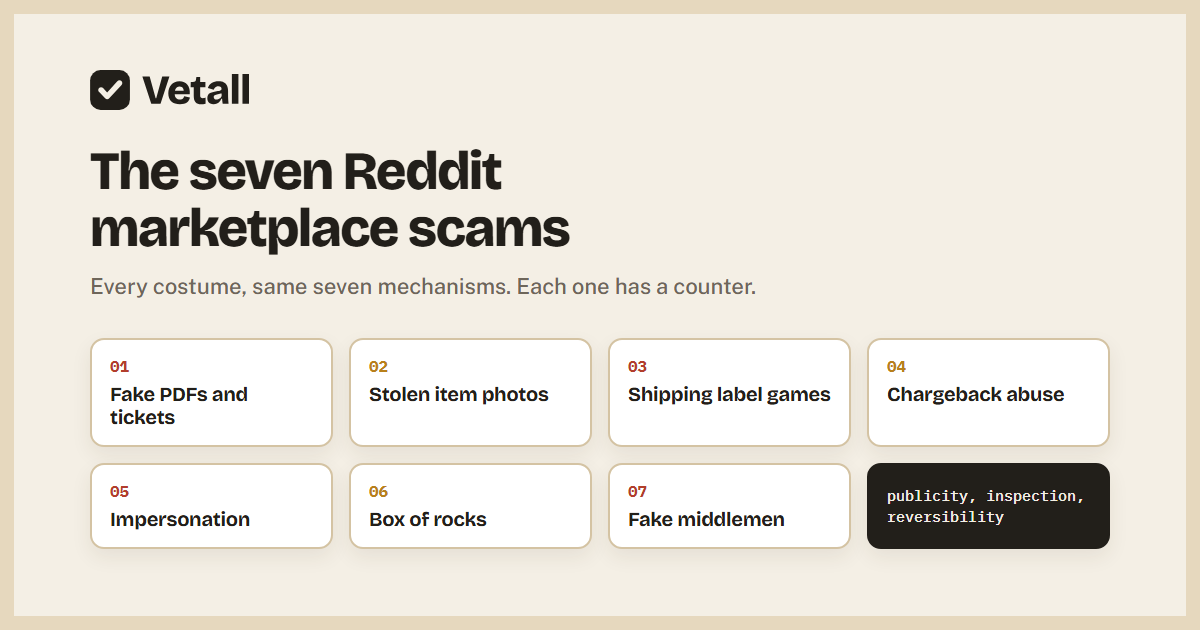
Marketplace scams look endless from the outside. They are not. Strip the costumes away and you find a small set of working mechanisms, each with a specific counter. Learn the mechanism and the costume stops mattering.
Why the same scams keep recycling
Reddit trades run between anonymous people, with no escrow, no built-in ratings, and payment methods that are often irreversible. Those are structural facts, so the scams that exploit them are structural too. When one stops working in a subreddit whose moderators have seen it a hundred times, it moves to a subreddit whose members have not. The seven below cover most of what actually lands.
Two things are worth noticing before the list. Almost every mechanism needs you to skip one specific, boring precaution, which is why they all travel with urgency attached. And almost every one needs a payment that cannot be reversed, which is why the method gets negotiated early and firmly. Keep those two constants in view and the variations become much easier to read.
The seven mechanisms
1. The fake PDF or ticket
The product is a file: a ticket, a licence key, a voucher. Files copy for free, so the same barcode can be sold to any number of buyers, or be invalid from the start. You cannot inspect pixels. The counter is to never buy pixels: insist on transfer through the official platform, or meet where the item is verified, such as the venue gate.
2. Stolen item photos
The listing looks real because the photos are real. They just belong to someone else's old listing. The seller never had the item. The counter is the timestamp: a photo of the item with a handwritten note showing your username and today's date. An honest seller produces one in minutes. A photo thief cannot.
3. Shipping-label games
Tracking says delivered, so the dispute closes, but what was posted was an empty envelope, or a label addressed to a different building in your postcode. The counter: pay by a method whose dispute process looks at what was actually received, keep the packaging, photograph everything on arrival, and use signature on delivery for anything expensive.
4. Chargeback abuse against sellers
This one runs the other way. A buyer pays with a protected method, receives the item, then claims it never arrived or files a card chargeback. The counter for sellers: tracked postage with signature, photos of serial numbers before packing, and a short video of the box being sealed. Protection systems reward whoever kept the better records, and it is why experienced sellers sound as cautious about new buyers as buyers are about new sellers.
5. Account impersonation
A scammer copies the username of a reputable trader, with one character swapped or doubled, then answers interested buyers in private messages while the real seller sleeps. The counter: deal only with the account that actually posted the listing, check the spelling character by character, and confirm the deal with a public comment in the thread before paying.
6. The box of rocks
Real tracking, plausible weight, wrong contents. You paid for a graphics card and signed for gravel. The counter: film the unboxing in one unbroken shot, verify serial numbers before confirming receipt, and pay by a method that lets you dispute an item that is not as described, not just one that never arrived.
7. Middleman impostors
Someone suggests a trusted middleman to hold the item or the money, and the middleman is the scammer's other account. The counter: real middlemen are listed by subreddit moderators, and you verify them through modmail, never through a link or username the other party hands you.
The shape behind all seven
Every mechanism above attacks one of three protections: publicity, inspection, or reversibility. Fake files and stolen photos defeat inspection. Impersonation and fake middlemen defeat publicity by moving the deal somewhere witnesses cannot follow. And every single one of them prefers a payment that cannot be pulled back. Which means the defence compresses nicely: keep the deal public, verify the item or the transfer directly, and pay in a way you can reverse. A deal that survives all three survives most of what has not been invented yet.
This is also why lists of specific scams age badly while the counters do not. The costume changes with whatever is scarce that season: consoles one year, graphics cards the next, concert tickets every summer. The mechanism underneath barely moves, because it is shaped by the structure of the marketplace rather than by the product on sale.
Check the account before the deal
Each counter above tests the deal. Vetall tests the counterparty. A check reads roughly two hundred of the account's recent public comments and posts, reduces them to measurements such as account age, posting rhythm, repeated text and the share removed by moderators, and an AI weighs the patterns into a 0 to 100 score with a band, the signals behind it and one line of advice. An account too thin to judge says so instead of guessing. It will not spot a fake PDF for you, but it will often tell you the account offering one has no life beyond selling.
The band is visible on any account someone has already checked, so busy marketplace threads accumulate coverage over time. Your own checks show the full score, the signals and the advice line, and each one stays unlocked for you permanently.
See the risk before you reply.
A badge on every Reddit username, built from the account's public history. 7 full checks free, and accounts checked by anyone show their band to everyone, free forever.
Add Vetall to Chrome, freeNo card required.