Guide
Buying PC parts on Reddit: red flags in hardware trades
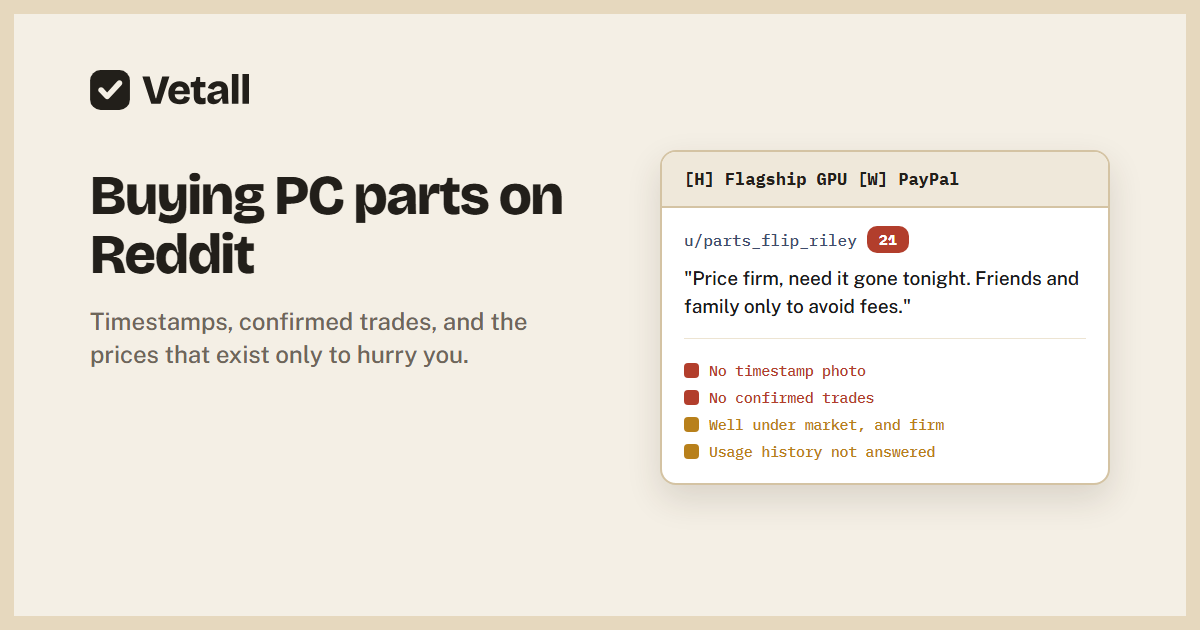
Hardware trading subreddits are one of the friendliest corners of the used market: real enthusiasts, good prices, strict rules. The rules exist because the stakes are high. A graphics card is small, expensive, easy to post, and impossible to inspect through a photo, which makes it exactly what a scammer wants to pretend to sell.
How the trading subs actually work
Communities in the hardwareswap mould run on structure: rigid title formats stating location, what is offered and what is wanted, confirmed-trade threads that count completed deals, flair that displays the count, and rules that keep negotiation in public comments before anything moves to private messages. None of this is bureaucracy for its own sake. Every rule is a scar from a scam that worked once. Your first check is simply whether the seller operates inside that structure or around its edges, because scammers treat the rules as friction and it shows.
Read the sub's own rules page before your first trade. Every requirement that feels fussy, the title format, the comment-before-DM rule, the timestamp, exists because someone lost real money without it. The rules are the collected memory of the community's worst weeks, offered to you for free.
Timestamps, and why moderators are strict about them
The timestamp rule asks the seller to photograph the item beside a handwritten note with their username and the date. It proves possession today, which is the one thing photos lifted from an old listing can never show. Look at the note itself: does the username match exactly, is the date current, does the handwriting appear in every photo of the set? A seller who resists producing a fresh one for a serious buyer, or reuses last month's, has failed the cheapest test in the hobby.
Reverse image search is the companion test. Drop the listing photos into a search engine and see whether they lead back to a retailer, a review site, or someone else's older listing. It takes under a minute, and it is the fastest way to catch a listing assembled from other people's pictures.
Confirmed trades are strong evidence, not proof
A long confirmed-trade history is the best signal these subs offer, and it is still not a guarantee. Flair belongs to the account, and accounts get bought and stolen precisely because flair follows them. So read the history for continuity, not just quantity. Does the current listing fit the pattern of what this person has traded before? A steady trader of fans and cables who suddenly lists five flagship graphics cards at once has either had a windfall or a change of ownership, and it costs nothing to ask which.
The same logic applies to account age and karma. Both are bought and sold, which is why a strong-looking profile and a listing that does not fit it should be read together, not separately. Continuity is the signal. Credentials are just the costume it wears.
The price that answers no question except why
Under-market prices are the fuel that makes every other trick work, because they make you afraid of losing the deal to someone faster. Ask the boring question: what does a genuine owner gain by selling well below the going rate, urgently, to a stranger? Sometimes there is a real answer, a house move, an upgrade, a divorce. The word firm plus the word tonight plus a price nobody else can match is not usually that answer.
Price also sets your protection budget. The deeper the discount, the more the deal depends on speed, and the less room you have for tracked shipping, Goods and Services fees and patience. A price that only works if you skip the safeguards is not a price. It is a filter for people who skip safeguards.
Mining wear, honestly
Some used graphics cards have spent part of their lives mining or running around the clock, and you often cannot tell from the outside. Treat it as a risk to verify rather than a reason to panic: constant load ages fans and thermal interfaces more than it ages the silicon, and a card can be perfectly fine. What matters is whether the seller helps you verify. Ask how the card was used, ask for a stress-test screenshot with temperatures, ask about the purchase receipt and remaining warranty. An honest seller volunteers this history. A vague one, on a card priced to move, is asking you to buy the question unanswered.
For the handover itself, prefer tracked, signature-on-delivery shipping, and film the unboxing in one unbroken take. Small, dense, expensive parts are exactly the category where the box-of-rocks routine gets used, and the video is what wins that dispute if it ever happens.
The check before the check
All of the above is about one seller, read by hand. Vetall reads the account for you first: a check runs through roughly two hundred recent public comments and posts, measures account age, the balance between posts and comments, posting rhythm, repeated text, moderator-removed share and subreddit spread, and an AI weighs those patterns into a 0 to 100 score with a band, up to three signals and one line of advice. A years-old account that lives in build logs and case photos reads very differently from one that appeared last month selling in six trading subs, and the badge tells you which is which before you open the timestamp album.
Vet the trader before the trade.
A badge on every Reddit username, built from the account's public history. 7 full checks free, and accounts checked by anyone show their band to everyone, free forever.
Add Vetall to Chrome, freeNo card required.